High-Tech Welfare for High-Tech Billionaires
Voters in a New Mexico county appear to have approved a tax increase to build the nation’s first commercial spaceport. Two other counties will also hold tax referendums before the project can proceed. British billionaire Richard Branson and his company Virgin Galactic have signed a long-term lease to use the spaceport.
But why should the taxpayers of rural New Mexico be paying for facilities for billionaire space entrepreneurs If the spaceport is going to be profitable, then businesses could pay for it. And even if it weren’t profitable, the space business has attracted the attention of a lot of people with a sense of adventure and billions of dollars, from Branson to Microsoft cofounder Paul Allen, the seventh richest man in America.
The argument to spend tax dollars on the spaceport is very similar to the argument for tax-funded stadiums and convention centers. Proponents say it will bring jobs and tax revenues to the three rural counties. But apparently it isn’t a sure enough thing for businesses to invest their own money.
Cato scholars have argued for years against corporate welfare. The spaceport is a classic example of corporate welfare, though in this case it might better be called billionaire welfare. It will transfer money from middle-class and working people to subsidize businesses and billionaires who won’t have to invest their own money — just like the typical stadium deal, paid for by average taxpayers to benefit millionaire players and billionaire owners.
At least in this case the voters get to decide, which rarely happens with stadium subsidies. The vote pitted “political, business and education leaders” against retirees and groups representing the poor.
“I’m not opposed to the spaceport, but I think it’s a terrible idea to tax poor people to pay for something that will be used by the rich,” said Oscar Vasquez Butler, a county commissioner who represents many of the unincorporated rural colonias where the poorest New Mexicans live, often without proper roads and water and sewage systems. “They tell us the spaceport will bring jobs to our people, but it all sounds very risky. The only thing we know for sure is that people will pay more taxes.”
Posted on April 6, 2007 Posted to Budget & Tax Policy,Cato@Liberty,Economics & Economic Philosophy,Government & Politics,Science & Space,Tech, Telecom & Internet,Welfare & Workforce
John Edwards and Family Decisions
More than a week after Senator John Edwards’s decision to remain in the presidential race despite the recurrence of his wife Elizabeth’s cancer, pundits are starting to sharply criticize the decision. They say that he is consumed by ambition and that his priorities are out of whack. They say that he should be spending time with his wife and especially with his two small children.
I had a similar reaction: these two children need their parents with them now more than ever. They may lose their mother soon. And if their father spends two years campaigning, they won’t see much of him. If his campaign is successful, they won’t spend time much time with him for the rest of their childhood.
But who am I to judge the intimate family decisions of John and Elizabeth Edwards I can’t possibly know as much about their values and goals as they do.
If John and Elizabeth Edwards have spent the past ten—or fifteen—or twenty years working toward the White House, it may well be their very considered decision that that effort should continue. In particular, it may be that the one thing Elizabeth Edwards wants most in her life is to see her husband in the White House. Assuming that Elizabeth Edwards genuinely believes that John would be a good president (I don’t, but I’m not making the decision), then she may very well have decided that what he can do for the country is more important than what he can do for his children. As Rick said to Ilsa in Casablanca, “it doesn’t take much to see that the problems of three little people don’t amount to a hill of beans in this crazy world.”
So pundits would do well to assume that no one knows the trade-offs involved in the Edwardses’ decision better than the Edwardses. In this case, as in so many others, it makes sense to let the people most closely involved in the decision make that decision.
But here’s the irony. John Edwards doesn’t believe that families should be allowed to make the important decisions about their lives. He doesn’t think families should be allowed to decide where their children will go to school. He doesn’t think families should be allowed to decide how or whether to save for retirement. He doesn’t think families should be allowed to decide what drugs to use, either pharmaceutically or recreationally. He supports a national health care system that would deny families the right to choose their own doctor.
In this presidential year, it would be good for Americans to reaffirm our commitment to the principle that families—not pundits and not government—should make the important decisions about their lives.
Posted on April 3, 2007 Posted to Cato@Liberty,Government & Politics
Is libertarianism history?
American liberals have some shameful things in their past. But what about the conservatives?
On Sunday the New York Times ran a remarkably ill-informed reviewof Radicals for Capitalism: A Freewheeling History of the Modern American Libertarian Movement by Brian Doherty.
Over at Cato@Liberty, I responded in great detail. Noting reviewer David Leonhardt’s litany of embarrassing moments in libertarian history, I argued:
If that’s the sum total of embarrassing libertarian moments, it’s a pretty darn good record over 70 years or so. Modern liberals have to deal with the fact – not an embarrassing fact but a shameful one – that many of their forebears supported Stalin and the Communist party, or were at least fellow-travellers.
As for conservatives, I could mention their long resistance to liberty and legal equality for blacks, women, and gays, but instead I’ll just say: George W Bush and the Iraq war. In 70 years, libertarians have done nothing to compare to expressing support for limited constitutional government while also supporting Bush, his disastrous war, and his accumulation of unprecedented presidential power.
And I concluded: “No book is perfect, nor is any movement. But contra Leonhardt, Radicals for Capitalism is going to be the standard history of the libertarian movement for years to come. And it tells a story libertarians can be proud of.”
The book is about the American libertarian movement, which will obviously reduce its appeal on the other side of the Atlantic. But it’s a fine work of political history.
Posted on April 3, 2007 Posted to Comment,Comment is free,guardian.co.uk,Newspapers & magazines,The Guardian,World news
Is libertarianism history?
American liberals have some shameful things in their past. But what about the conservatives?
Posted on April 3, 2007 Posted to The Guardian
Is libertarianism history?
American liberals have some shameful things in their past. But what about the conservatives
Posted on April 3, 2007 Posted to The Guardian
Sandy Berger, Music Fan?
Someone, most likely an aging baby boomer with sticky fingers, has been lifting CDs from the music library at the Voice of America, which uses them for its radio shows. Looks like an inside job. The library is open only to employees. The M.O. is that the person goes into the stacks and takes the CD but leaves the plastic case.
The thefts were noticed recently when someone tried to check out a Judy Collins disc but found only an empty case. In fact, the entire Collins collection is gone. A check of other collections showed that Peter, Paul & Mary and Bob Dylan recordings were also missing.
Posted on April 2, 2007 Posted to Cato Publications,Cato@Liberty,General,Government & Politics
If Only Our Government Were More like Italy’s
The International Institute for Democracy and Electoral Assistance compared voter turnout in national elections from 1945 to 1998 in 140 countries. Italy ranked first, with 92 percent, and the United States was 139th, with an average turnout of 48 percent.
–Bill Bradley in the Washington Post
Posted on April 2, 2007 Posted to Cato@Liberty,General,Government & Politics
Hillary Didn’t Invent Community
In an article on a pleasant suburban community near Washington, Roxanne Sweeney says, “It’s like ‘Leave It to Beaver,’” praising the neighborhood’s friendliness and strong community ties. Later, reporter Rebecca Kahlenberg writes,
Recently, a group of River Falls mothers used the e-mail group to coordinate food preparation for Roxanne Sweeney when she wasn’t feeling well following treatment for colon cancer.
“I can’t even count how many meals were brought to me,” Sweeney said. “I hate this line because I’m not a Democrat, but this is really an it-takes-a-village sort of place.”
No, Ms. Sweeney! Friendship and community were not invented by Hillary Clinton. As the reference to “Leave It to Beaver” suggests, such ties go back long before Senator Clinton put her name on the book “It Takes a Village.” And long before “Leave It to Beaver.” Family, parish, and village are natural connections that predate not just Clinton but government and even formal social organization. They are the first building blocks of civil society. Clinton’s contribution to the topic is to confuse the natural ties of love and neighborliness with the artificial and imposed order of a vast and distant federal government.
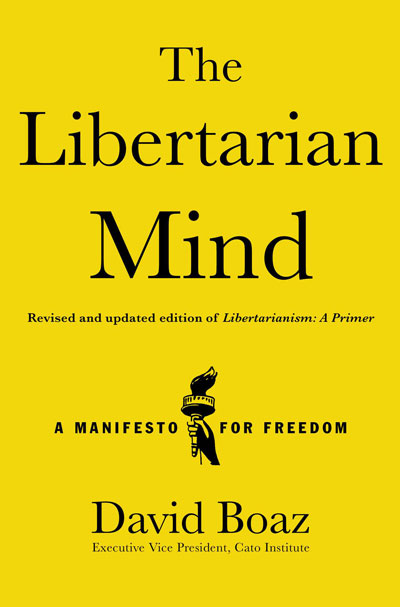
As I wrote in a recent article and in Libertarianism: A Primer, Hillary calls for a national consensus and a common vision of what the government should do for families. But there can be no such common consensus in a pluralistic society. People don’t agree about all the values involved in rearing children, helping others, worshiping God, and forming associations. That’s why a successful society leaves such choices to individuals. Even in the little community of River Falls, it isn’t a formal community organization that came to Roxanne Sweeney’s aid. It was her friends.
At so many points in our lives, it takes friends, it takes a village, but it doesn’t take the federal government.
Posted on April 1, 2007 Posted to Cato@Liberty,General,Government & Politics,Libertarian Philosophy
NYT Clueless on Libertarianism
In Sunday’s New York Times, Times economics columnist David Leonhardt reviews Radicals for Capitalism: A Freewheeling History of the Modern American Libertarian Movement by Brian Doherty.
It might have made sense to get a libertarian, or someone familiar with the libertarian movement, or a political historian to write the review. Instead, the Times turned to someone who knows something about economics. Since the Times is the most important book review venue in the country, it’s worth taking a close look at Leonhardt’s complaints.
The first half of the review retells the story of Ayn Rand and the Objectivists, which is fine. It’s an interesting story, though it’s probably the part of the book most likely to be already familiar to Times readers. After the Randian opening, Leonhardt writes:
The story of the American libertarian movement, like the story of its most famous salon, has been a combination of small numbers and big influence. It has never really emerged from the fringe, for the simple reason that most Americans want their government to educate the young and care for the old. But over the last few decades, they have also grown increasingly skeptical of collectivist policies that go beyond the basics. Libertarian thinkers — Rand, Milton Friedman, Murray Rothbard and others — have helped foment this skepticism and then enthusiastically pointed to the alternative.
Fair enough. Most movements are small, even those that have big effects. “Fringe” is a subjective issue; if a movement produces several Nobel laureates and a chairman of the Federal Reserve Board, and plays a role in such policy reforms as the end of the draft, deregulation, sharply reduced taxes, and freer trade, is it still on the fringe
Posted on March 31, 2007 Posted to Cato Publications,Cato@Liberty,General,Libertarian Philosophy
Heartland Insurgency
On Tuesday, it was Nebraska senators Chuck Hagel (R) and Ben Nelson (D) who provided the winning margin for a Senate bill to begin a phased withdrawal of troops from Iraq.
Today it’s five-term congressman Lee Terry (R-Neb.) deciding that Attorney General Alberto Gonzales should resign.
Pretty soon, the neocons are going to be calling for an invasion of Nebraska.
Posted on March 31, 2007 Posted to Cato@Liberty,Defense & National Security,Domestic Issues,Government & Politics,Law & Legal Issues



 RSS
RSS