Is America’s nanny state growing?
Despite bans on smoking and trans-fats, we’re not necessarily less free.
Posted on October 15, 2007 Posted to The Guardian
Not Burying the Good News
The New York Times reports:
Death rates from cancer have been dropping by an average of 2.1 percent a year recently in the United States, a near doubling of decreases that began in 1993, researchers are reporting.
“Every 1 percent is 5,000 people who aren’t dying,” said Dr. Richard L. Schilsky, a professor of medicine at the University of Chicago and president-elect of the American Society of Clinical Oncology. “That’s a huge sense of progress at this point.”
I’ve complained in the past that good news like this gets buried or ignored, while even minor bits of bad news make the front pages. In this case the good news was bannered on the front page of USA Today and was the lead story on the CBS Radio News. (It was on page A18 of the Times, but teased on page 1.)
The Times did manage to find the cloud in the silver lining: As is universally the case in all human affairs, the decline is not uniform across all demographic groups. In particular, groups who still have high rates of smoking are not seeing cancer declines as large as other groups. But the news still fits the message of Indur Goklany’s book, The Improving State of the World: Why We’re Living Longer, Healthier, More Comfortable Lives on a Cleaner Planet
Posted on October 15, 2007 Posted to Cato@Liberty
Lomborg on Gore
At the Guardian’s “Comment is free” site, skeptical environmentalist Bjorn Lomborg has some tart words for the Nobel committee:
This year’s Nobel Peace Prize justly rewards the thousands of scientists of the United Nations Climate Change Panel (the IPCC). These scientists are engaged in excellent, painstaking work that establishes exactly what the world should expect from climate change.
The other award winner, former US vice president Al Gore, has spent much more time telling us what to fear. While the IPCC’s estimates and conclusions are grounded in careful study, Gore doesn’t seem to be similarly restrained.
Gore told the world in his Academy Award-winning movie (recently labelled “one-sided” and containing “scientific errors” by a British judge) to expect 20-foot sea-level rises over this century. But his Nobel co-winners, the IPCC, conclude that sea levels will rise between only a half-foot and two feet over this century, with their best expectation being about one foot – similar to what the world experienced over the past 150 years. …
The IPCC engages in meticulous research where facts rule over everything else. Gore has a very different approach.
Posted on October 12, 2007 Posted to Cato@Liberty
David Harsanyi’s Nanny State
In the Washington Post today, Anita L. Allen of the University of Pennsylvania reviews Nanny State: How Food Fascists, Teetotaling Do-Gooders, Priggish Moralists, and Other Boneheaded Bureaucrats Are Turning America into a Nation of Children by David Harsanyi. She makes a point that I’ve thought a lot about in discussions of our growing “nanny state”:
But Americans were never as free as Harsanyi imagines….
It is true that in 1960 U.S. automobile drivers did not have to wear seat belts. But overreaching rules of other sorts reigned supreme. Under “blue laws,” most retail stores and virtually all liquor stores were closed on Sundays, presumably so everyone could stay sober and go to church. More profoundly, in 1960 married couples could not legally obtain birth control in Connecticut, mixed-race couples could not marry in Virginia, black kids in Georgia attended underfunded segregated public schools and homosexual sex was against the law.
No free-marketer, Allen leaves out a few other attributes of 1960, like 90 percent income tax rates and rigid regulation of transportation, communications, and finance.
Open the newspaper on any random page, and you can find evidence of the growing tendency to meddle in our lives: seat-belt laws, smoking bans, trans-fat bans, potty parity, and on and on. But are those things worse than the older laws that Allen cites? And if you go back further than she did, you can find worse indignities: established churches, slavery, married women denied property rights. So while we should deplore the deprivations of freedom that Harsanyi explores, we should not necessarily conclude that we’re progressively less free.
Allen also complains that
Readers have to wait until the final pages of this book to learn exactly why Harsanyi thinks the nanny state is a bad thing. The nanny state creates a moral hazard, he claims. “People act more recklessly when (purported) risk is removed.” Plus, “the rigidity of nanny regulations does not allow consumers to practice common sense and protect themselves.”
That’s a good consequentialist reason to oppose the nanny state, but it’s not the best reason. The real reason that we should be free to make our own decisions about seat belts, smoking, and fatty foods is that we’re adults; that we’re endowed by our Creator with the unalienable rights of life, liberty, and the pursuit of happiness; that to be free is to have moral autonomy and personal responsibility.
Still, any author should be thrilled to have the Washington Post recommend that we “read Harsanyi as a 21st-century John Stuart Mill.”
Posted on October 11, 2007 Posted to Cato@Liberty
Voting on Historical Truth
As the House Foreign Affairs Committee passes a resolution to call the mass killings of Armenians that began in 1915 “genocide,” defying all eight living former secretaries of state, who signed a joint letter saying that such a resolution by Congress would seriously harm U.S. relations with Turkey, I recommend the thoughts of a young Armenian-American writer, Garin Hovannisian:
As the great grandson of genocide survivors, the grandson of genocide historians, and the son of Armenian repatriates — though writing, I’m afraid, without the sanction of the generations — I am insulted by that sticker. That Congress “finds” the genocide to be a fact makes the tragedy no more real than its refusal, so far, has made it unreal. Truth does not need a permission slip from the state.
As an heir, moreover, of an American tradition of limited government, I am annoyed that the legislature is poking into a sphere in which it has neither business nor experience: the province of truth. It is bad enough that a committee of aristocrats governs the conventions of politics, economics and human rights. We the citizens scarcely need to sign over the laws of nature, too, lest gravity be repealed and the whole race goes floating about the universe.
Posted on October 11, 2007 Posted to Cato@Liberty
Where’s Vargas Llosa?
Doris Lessing is no doubt a deserving recipient of the Nobel Prize in Literature, and given her advancing age the Swedish Academy may well have felt that recognizing her was urgent. But I can’t help noting what the Washington Post’s book critic, Jonathan Yardley, said on Sunday:
In the world at large [Mario Vargas Llosa] is known as one of the leading writers in the Latin American literary “Boom,” his acclaim today probably exceeded only by that lavished upon Gabriel Garcia Marquez. That he has not been awarded the Nobel Prize in Literature is nothing short of scandalous.
After deploring the “many nonentities to whom the prize has gone in recent years,” Yardley suggests a possible reason for the continuing error:
Doubtless the prize went to Garcia Marquez on merit, but doubtless as well his cozy relationship with Fidel Castro helped his cause; Vargas Llosa by contrast is of a more conservative persuasion, and this the complacently ideological Swedes do not countenance, much less honor.
If Yardley read Vargas Llosa’s nonfiction as carefully as his fiction, he would note that the great author considers himself a liberal, not a conservative. But the social democrats of Sweden dislike real liberalism as much as conservatism.
Posted on October 11, 2007 Posted to Cato@Liberty
Krugman Misunderstands Conservatism
Paul Krugman declares that, contrary to those who think the Republican party has lost its way in the Bush years, President Bush is “the very model of a modern movement conservative.”
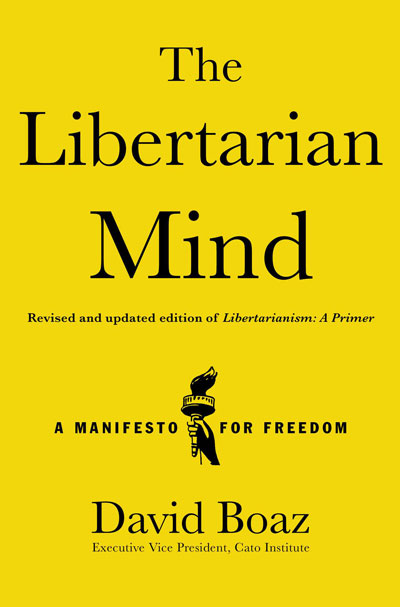
Maybe he’s talking about me, since I’ve criticized Bush’s policies as ”a far cry from the less-government, ‘leave us alone’ conservatism of Ronald Reagan.” I also wrote a whole book distinguishing libertarianism from both liberalism and conservatism, so I’m no spokesman for movement conservatism. But I can see the weaknesses in Krugman’s case. Krugman has a new book out titled The Conscience of a Liberal, but he doesn’t seem to have read — or at least understood – The Conscience of a Conservative.
Krugman writes:
People claim to be shocked by Mr. Bush’s general fiscal irresponsibility. But conservative intellectuals, by their own account, abandoned fiscal responsibility 30 years ago. Here’s how Irving Kristol, then the editor of The Public Interest, explained his embrace of supply-side economics in the 1970s: He had a “rather cavalier attitude toward the budget deficit and other monetary or fiscal problems” because “the task, as I saw it, was to create a new majority, which evidently would mean a conservative majority, which came to mean, in turn, a Republican majority — so political effectiveness was the priority, not the accounting deficiencies of government.”
But Irving Kristol is hardly a conservative standard-bearer. As Ed Crane has been pointing out for years, the neoconservatives brought big-government ideas into the limited-government movement of Barry Goldwater and William F. Buckley Jr., and the supply-siders ducked the issue of government spending to focus strictly on tax cuts. Bush may be the ultimate supply-side neocon, but that doesn’t make him a model conservative.
Krugman also writes:
People claim to be shocked by the Bush administration’s general incompetence. But disinterest in good government has long been a principle of modern conservatism. In “The Conscience of a Conservative,” published in 1960, Barry Goldwater wrote that “I have little interest in streamlining government or making it more efficient, for I mean to reduce its size.”
But Bush didn’t reduce government’s size. He increased it by one trillion dollars in six years. Seems like Bush and Krugman both sort of missed Goldwater’s point. (more…)
Posted on October 8, 2007 Posted to Cato@Liberty
Shockingly Bad
Cato adjunct scholar Tyler Cowen takes on Naomi Klein’s book Shock Capitalism in the New York Sun:
Rarely are the simplest facts, many of which complicate Ms. Klein’s presentation, given their proper due. First, the reach of government has been growing in virtually every developed nation in the world, including in America, and it hardly seems that a far-reaching free market conspiracy controls much of anything in the wealthy nations. Second, Friedman and most other free market economists have consistently called for limits on state power, including the power to torture. Third, the reach of government has been shrinking in India and China, to the indisputable benefit of billions. Fourth, it is the New Deal — the greatest restriction on capitalism in 20th century America and presumably beloved by Ms. Klein — that was imposed in a time of crisis. Fifth, many of the crises of the 20th century resulted from anti-capitalistic policies, rather than from capitalism: China was falling apart because of the murderous and tyrannical policies of Chairman Mao, which then led to bottom-up demands for capitalistic reforms; New Zealand and Chile abandoned socialistic policies for freer markets because the former weren’t working well and induced economic crises.
My old friend Steve Horwitz asks Klein a couple of pointed questions:
1. You say that crises are opportunities for free market ideologues to force their preferred policies through in violation of democratic processes. However, in the gravest crisis of the 20th century, the Great Depression, it was government that grew enormously, and the free market was restricted, in ways never before seen in the US….How do you reconcile the main thesis of your book with the historical evidence that government has grown and markets have been made less free in almost every crisis of the 20th century? …
2. In the aftermath of the biggest crisis in the US of the 21st century (9/11), government spending has grown enormously, government regulations have expanded, and civil liberties are threatened. Each of these are results that people like Milton Friedman and many other classical liberal free market economists not only oppose, but oppose precisely because they are antithetical to the very free market reforms they would like to make. … What gives? It certainly seems like crises produce a lot more government and a lot less free market reform.
Horwitz is making the same point Justin Logan made recently; as Bruce Porter and Robert Higgs have shown, much of the growth of government throughout American history (and elsewhere) has been a result of crises like wars and depressions. Sometimes, it’s true, an economic crisis may precipitate economic reforms, as in New Zealand in the mid-1980s. But the historical record shows that states usually seek more power, not less, when confronted by a crisis.
Pinochet’s economic reforms in Chile, of course, are a centerpiece of Klein’s argument. Pinochet was a military dictator, the argument goes, and he implemented the policies of Milton Friedman. QED. But there are lots of military dictatorships — Wikipedia counts 34 in Latin America — and Pinochet’s junta seems to have been the only one to pursue free-market policies. It’s an exception, not a rule. Which is hardly surprising: military men tend to be attuned to hierarchy and control, not to the undirected diversity of a market economy.
Posted on October 8, 2007 Posted to Cato@Liberty
Bush the Budget Warrior
After six and a half years of spending faster than LBJ, President Bush has decided to proclaim himself the guardian of the taxpayers, accusing Democrats of “working to bring back the failed tax-and-spend policies of the past.” The very recent past, perhaps? Today he complained that Congress has not yet completed appropriations bills for the fiscal year that begins Monday, and warned that Democrats shouldn’t send him an omnibus bill that would “make it easier for members to sneak in all kinds of special projects, put in wasteful spending or pork barrel that they are not willing to debate in the open.”
Republicans protecting the taxpayers from the tax-and-spend Democrats. It’s a golden oldie. But it doesn’t have much relevance in the past decade. As the chart below indicates, spending has risen more than twice as much in Bush’s first seven budgets as it did in Clinton’s eight years.

If President Bush is indeed going to be a fiscal conservative for the last one-sixth of his term, that’s good news. But he has already raised annual federal spending by more than one trillion dollars, and he’s not planning to reduce spending, just to slow the growth from a massively bloated base. Fiscal conservatism remains an orphan in today’s Washington.
Posted on September 24, 2007 Posted to Cato@Liberty
Hillary Hates Freedom
Maybe that’s a bit strong. Let’s just say, Sen. Hillary Rodham Clinton operates with reckless disregard for individual freedom and the limited government that protects and sustains it.
In her latest salvo, she dismisses the great promises of the Declaration of Independence, the founding principles of the United States, as rhetorical flourishes, mere garnishes on the real stuff of life. “We can talk all we want about freedom and opportunity, about life, liberty, and the pursuit of happiness, but what does all that mean to a mother or father who can’t take a sick child to the doctor?” she asked.
In her senatorial activities and her presidential campaign, Clinton has tended to propose modest, moderate programs. Even her new health care proposal is being hailed as more modest than her 1993 plan (though it would in fact impose a new government mandate on every person in the United States). But at her core, Hillary Clinton rejects the fundamental values of liberalism, values like individual autonomy, individual rights, pluralism, choice, and yes, life, liberty, and the pursuit of happiness. She seems to see no area of life that should be free from the heavy hand of government. And to her the world of free people seems a vast nothingness. When a few Republicans proposed to eliminate the National Endowment for the Arts, which spends about $125 million of the $63 billion spent on arts in the United States, she declaimed that such a move “not only threatens irrevocable damage to our cultural institutions but also to our sense of ourselves and what we stand for as a people.”
After her first attempt at nationalizing and bureaucratizing American health care, she told the New York Times that her next project would be “redefining who we are as human beings in the post-modern age.” I’d say 300 million Americans can do that for themselves.
Her hostility to freedom is not just a left-wing attitude. In the Senate, she’s been adding the paternalistic agenda of the religious right to her old-fashioned liberal paternalism. Clinton has called for federal legislation to prohibit the sale of “inappropriate” video games to children and teens. She’s introduced a bill to study the impact of media on children, a likely prelude to restrictions on television content, and she touts the V-Chip regulation that President Bill Clinton signed. She supports federal legislation to outlaw flag desecration (though not a constitutional amendment).
In her book It Takes a Village, she insisted that 300 million free people could somehow come to “a consensus of values and a common vision of what we can do today, individually and collectively, to build strong families and communities.” She told Newsweek, “There is no such thing as other people’s children,” a claim that ought to frighten any parent. She promised to inflict on free citizens government videos running constantly in every gathering place, telling people “how to burp an infant, what to do when soap gets in his eyes, how to make a baby with an earache comfortable”—all the things that no one knew how to do until the federal government came along.
Hillary Clinton is no socialist. But when she makes her rejection of liberal values as explicit as she did on Monday – dismissing “freedom and opportunity [and] life, liberty, and the pursuit of happiness” as irrelevant to people’s real lives–she is far too reminiscent of some of the most authoritarian figures of the 20th century. Lenin, for instance, wrote, “Bourgeois democracy is democracy of pompous phrases, solemn words, exuberant promises and the high-sounding slogans of freedom and equality.”
And maybe it’s no surprise that Clinton cosponsored her videogame ban with Sen. Rick Santorum, who is also an articulate and determined opponent of individualism. In his book It Takes a Family and in various media appearances, he denounced “this whole idea of personal autonomy.” At least once he rejected “the pursuit of happiness” explicitly, saying, “This is the mantra of the left: I have a right to do what I want to do” and “We have a whole culture that is focused on immediate gratification and the pursuit of happiness . . . and it is harming America.” Not the mantra of the Hillary Clinton left, obviously.
We know that societies that reject bourgeois freedom – the freedom of individualism, civil society, the rule of law, and yes, you guessed it, life, liberty, and the pursuit of happiness – in favor of collectivism and economic goods end up with neither freedom nor prosperity. The United States has the most advanced medical care in the world — The rate of death from heart disease in the U.S. was cut in half between 1980 and 2000, for instance – because we have a mostly free and capitalist economy. Mandates and regulations make medical care more costly than it needs to be, and Hillary Clinton now proposes to pile on yet more mandates and regulations. But the really scary prospect of another Clinton presidency is not what she would do to our medical care but what she would do to the “life, liberty, and the pursuit of happiness” that is the foundation of our free society.
Posted on September 18, 2007 Posted to Cato@Liberty



 RSS
RSS