Al Gore and the Constitution
Endorsing Barack Obama, Al Gore proclaims:
After eight years in which our constitution has been dishonored and disrespected, we need change.
He has a point. But he should have said sixteen years.
Posted on June 17, 2008 Posted to Cato@Liberty
Civil Liberties in Britain
David Davis, the shadow home secretary in the United Kingdom (that is, the prospective attorney general should the Conservative Party take power), has resigned his seat in the House of Commons to protest Parliament’s approval of a bill that would allow the government to hold terror suspects up to 42 days without charges.
Davis, generally regarded as a Thatcherite, said:
Until yesterday I took a view that what we did in the House of Commons representing our constituents was a noble endeavour because for centuries of forebears we defended the freedom of people. Well, we did, up until yesterday.
This Sunday is the anniversary of Magna Carta, a document that guarantees the fundamental element of British freedom, habeas corpus. The right not to be imprisoned by the state without charge or reason.
But yesterday this house allowed the state to lock up potentially innocent citizens for up to six weeks without charge.
He denounced the bill as “the one most salient example of the insidious, surreptitious and relentless erosion of fundamental British freedom” and went on to cite ID cards, “an assault on jury trials,” and “a DNA database bigger than any dictatorship has” as other elements of that erosion.
Davis said he would run in a special election to reclaim his seat by campaigning “against the slow strangulation of fundamental British freedoms by this government.” Observers expect him to win handily, as the Labour Party has fallen dramatically in the polls. But Conservative leader David Cameron has already appointed a new shadow home secretary, so Davis may have forfeited his leadership role.
I’m reminded of Phil Gramm, a Democratic congressman, who worked with President Reagan and the Republicans to cut taxes and spending in the early 1980s. When the Democratic leadership removed him from the Budget Committee, he switched to the Republican Party. Saying that the voters of his district should have the chance to decide whether they wanted a Republican representative, he resigned, ran in the special election as a Republican, was easily elected on Lincoln’s birthday, and the following year waltzed into the U.S. Senate.
Will Davis find such success by resigning and giving the voters a chance to assess his performance? Only time will tell… In the meantime, you can watch the video of his five-minute speech here.
Posted on June 12, 2008 Posted to Cato@Liberty
Whose Side Are You On?
In an article about the wave of conservative reform under Louisiana governor Bobby Jindal, the New York Times writes:
Meanwhile the House is considering an income tax cut that would cost the state $300 million.
Another way to say that would be:
Meanwhile the House is considering an income tax cut that would save the taxpayers $300 million.
It all depends on whether you identify with the taxpayers or the tax consumers.
Posted on June 2, 2008 Posted to Cato@Liberty
Surprise! Stadium Predictions Flawed
The Washington Examiner reports:
Attendance at Nationals Park has fallen more than a quarter short of a consultant’s projections for the stadium’s inaugural year, cutting into the revenue needed to pay the ballpark bonds and spurring a D.C. Council member to demand the city’s money back.
The District’s ability to pay down the debt on the publicly financed ballpark depends in part on the number of people who show up to the games, David Catania, independent at-large, wrote in a letter Tuesday to Chief Financial Officer Natwar Gandhi.
A study was commissioned in 2005 by Gandhi’s office. Written by Los Angeles-based Economics Research Associates, the report predicted attendance at the 41,000-seat ballpark would average 39,130 in year one, dropping to 32,737 in year four.
But paid attendance through 28 games has averaged only 29,141, Catania said, 26 percent lower than the consultant’s estimates. The Nationals are drawing the 15th-best crowd in baseball, according to ESPN, with a team that is in last place in the National League East and a 22-31 record as of Wednesday.
“It appears now,” Catania wrote, “that ERA may have seriously overestimated ticket sales, which represents a major portion of stadium-related revenues.”
Gandhi says it doesn’t matter, the bonds can be paid off with attendance as low as 10,000 per game. Which raises the question: if it’s that easy to pay for the stadium, why didn’t the multi-millionaire team owners agree to pay for it themselves?
Of course, these economic projections for subsidized stadiums are always vastly overstated. As Dennis Coates and Brad Humphreys wrote in a 2004 Cato study criticizing the proposed stadium subsidy, “The wonder is that anyone finds such figures credible.”
Several Cato studies over the years have looked at the absurd economic claims of stadium advocates. In “Sports Pork: The Costly Relationship between Major League Sports and Government,” Raymond Keating finds:
The lone beneficiaries of sports subsidies are team owners and players. The existence of what economists call the “substitution effect” (in terms of the stadium game, leisure dollars will be spent one way or another whether a stadium exists or not), the dubiousness of the Keynesian multiplier, the offsetting impact of a negative multiplier, the inefficiency of government, and the negatives of higher taxes all argue against government sports subsidies. Indeed, the results of studies on changes in the economy resulting from the presence of stadiums, arenas, and sports teams show no positive economic impact from professional sports — or a possible negative effect.
In Regulation magazine, (.pdf) Coates and Humphreys found that the economic literature on stadium subsidies comes to consistent conclusions:
The evidence suggests that attracting a professional sports franchise to a city and building that franchise a new stadium or arena will have no effect on the growth rate of real per capita income and may reduce the level of real per capita income in that city.
And in “Caught Stealing: Debunking the Economic Case for D.C. Baseball,” Coates and Humphreys looked specifically at the economics of the new baseball stadium in Washington, D.C., and found similar results:
Our conclusion, and that of nearly all academic economists studying this issue, is that professional sports generally have little, if any, positive effect on a city’s economy. The net economic impact of professional sports in Washington, D.C., and the 36 other cities that hosted professional sports teams over nearly 30 years, was a reduction in real per capita income over the entire metropolitan area.
And yet millionaire owners and mayors with Edifice Complexes keep commissioning these studies, and council members and editorial boards keep falling for them.
Posted on May 29, 2008 Posted to Cato@Liberty
So Much for the Past Seven and a Half Years
President Bush told Neil Cavuto of Fox News on Friday, “Fiscal conservatism is one of my defining issues for the remaining months.”
Posted on May 29, 2008 Posted to Cato@Liberty
A “West Wing” Rerun?
Peter Funt, son and heir of “Candid Camera” creator Allen Funt, writes that this year’s presidential race is shaping up like the final season of NBC’s “The West Wing”:
Good-looking congressman in his mid-40s, married with two young children, known for his inspirational speeches, comes from far behind to clinch the Democratic nomination and face an older, more experienced centrist Republican. If he wins, he’s America’s first non-Caucasian president.
Obama vs. McCain. But also “West Wing’s” Rep. Matthew Santos (Jimmy Smits) vs. Sen. Arnold Vinick (Alan Alda). Funt writes that the “West Wing” writers were in touch with Obama strategist David Axelrod as they created the Santos character, who was sort of a “test market” to “soften up millions of Americans for the task of electing the first minority president.” And he notes that Obama’s staffers “especially like the ending” of the “West Wing” plot, in which Santos narrowly defeats Vinick.
But Funt left out the part that might make Republicans more optimistic. After the libertarianish Vinick got the Republican nomination, former Democratic strategist Bruno Giannelli went to him and told him that with his image he could win a landslide victory: You, he said, “are exactly where 60 percent of the voters are: Pro-choice, anti-partial birth, pro-death penalty, anti-tax, pro-environment and pro-business, pro-balanced budget.”
The high point of the “West Wing” campaign was a debate that broke the rules of both presidential debates and television drama: The “candidates” threw out the usual formal debate rules and just questioned each other, and the actors improvised their questions and answers from a partially written script. They actually did two live performances that night, for the East Coast and the West Coast.
And in the debate, Vinick showed those libertarian-center colors against Santos’s tired old big-government liberalism dressed up in appeals to hope. The morning after that debate aired on NBC, libertarian-leaning Republicans told each other, “if only a real candidate could articulate our values as well as a liberal actor did!” Asked about creating jobs, Vinick declared, “Entrepreneurs create jobs. Business creates jobs. The President’s job is to get out of the way.” On alternative energy:
I don’t trust politicians to choose the right new energy sources. I believe in the free market. You know, the government didn’t switch us from whale oil to the oil found under the ground. The market did that. And the government didn’t make the Prius the hottest selling car in Hollywood. That was the market that did that. In L.A. now, the coolest thing you can drive is a hybrid. Well, if that’s what the free market can do in the most car-crazed culture on Earth, then I trust the free market to solve our energy problems. You know, you know, the market can change the way we think. It can change what we want. Government can’t do that. That’s why the market has always been a better problem-solver than government and it always will be.
His closing statement:
Matt has more confidence in government than I do. I have more confidence in freedom — your freedom; your freedom to choose your child’s school, your freedom to choose the car or truck that’s right for you and your family, your freedom to spend or save your hard-earned money instead of having the government spend it for you. I’m not anti-government. I just don’t want any more government than we can afford. We don’t want government doing things it doesn’t know how to do or doing things the private sector does better or throwing more money at failed programs because that’s exactly what makes people lose faith in government.
And after the debate, a Zogby poll found that even among the young, liberal-skewing viewers of “The West Wing,” Vinick had crushed Santos. Before the episode, viewers between 18 and 29 preferred Santos over Vinick, 54 percent to 37 percent. But after the debate, Vinick led among viewers under age 30, 56 percent to 42 percent. McCain could only dream of such numbers. Or maybe he should try sounding like Arnie Vinick.
“West Wing” producers were taken aback by the reactions of real live “voters” to their real live debate. After seven years of heroically portraying the honest, decent, liberal President Jed Bartlet–an idealized Bill Clinton who wouldn’t take off his coat, much less his pants, in the Oval Office–they weren’t about to let a crotchety old Republican beat their handsome Hispanic hero. So they conjured up a meltdown in a nuclear power plant that Vinick had supported, and Santos won the election.
If only the Republicans could nominate Arnie Vinick, and avoid an actual nuclear meltdown for the next six months, they might disrupt Peter Funt’s life-imitates-art speculations. But the writers–this time Obama’s fans in the mainstream media–might still insist on their own interpretation.
Posted on May 27, 2008 Posted to Cato@Liberty
Libertarian Voters and the Libertarian Party
The Libertarian Party is meeting in Denver to nominate a presidential candidate. Vying for the nomination are a former Democratic senator, a former Republican congressman, the author of the book Millionaire Republican, and a number of long-time party activists.
The party’s most successful presidential candidate was Ed Clark, who got 921,000 votes, about 1.1 percent, in 1980. Since then LP candidates have hovered around 400,000 votes.
Ron Paul’s surprising campaign this year and the increasing evidence about libertarian voters have generated more interest in the Libertarian Party nomination than usual, as witness the large and broad field of candidates.
So what’s the relationship between libertarian voters and the Libertarian Party? First, of course, members of the Libertarian Party are much more committed to the libertarian philosophy than are the libertarian-leaning voters David Kirby and I have identified in recent research. Our research indicates that 15 to 20 percent of American voters hold broadly libertarian views, yet the Libertarian Party has only once broken 1 percent in a presidential race. (More people have voted for LP candidates for lesser offices. The LP’s website claims that Libertarian candidates won 5.4 million votes in 1996.)
Libertarian voters have been more willing than other voters to vote for third-party candidates. In Beyond Liberal and Conservative, William S. Maddox and Stuart A. Lilie found that libertarians gave 17 percent of their votes to “other” candidates in 1980, presumably independent John B. Anderson and Libertarian Clark, though Clark and Anderson received only about 8 percent of the national total. In 1992 libertarians gave Ross Perot 33 percent, knocking George H. W. Bush from 74 percent of the libertarian vote in 1988 to 35 percent in 1992. Again in 1996, libertarians voted more heavily for Perot (13 percent) than did the national electorate (8 percent). So libertarian-leaning voters seem open to voting for third-party candidates, and thus they should be fertile ground for the Libertarian Party.
Posted on May 23, 2008 Posted to Cato@Liberty
Transatlantic Currents
British Prime Minister Gordon Brown is a serious, wonkish, deeply religious socialist who believes passionately in the power of government to do good for people — much like Hillary Clinton. For a decade or so he subordinated his own ambition for the top job, serving as a partner and adviser to a more charismatic political leader who reached the brass ring first — much like Hillary Clinton.
Finally, Tony Blair’s term ended and Brown got the big job. And he’s tanking. His approval rating (17 percent) is so low, he’s asking Bush for PR tips. The Labour Party not only lost the London mayor’s race, it just lost a seat in Parliament that it had held since World War II.
No wonder Rush Limbaugh was urging Republicans to vote for Hillary Clinton in the Democratic primaries. She delivered Congress to the Republicans once before, in 1994. And if she is indeed a lot like Gordon Brown, she could do it again.
Posted on May 23, 2008 Posted to Cato@Liberty
Full profile
David Boaz is the executive vice-president of the libertarian Cato Institute, a non-profit-making public policy research foundation headquartered in Washington DC. He is a leading authority on US domestic issues such as education choice, drug legalisation, the growth of government, and the rise of libertarianism.
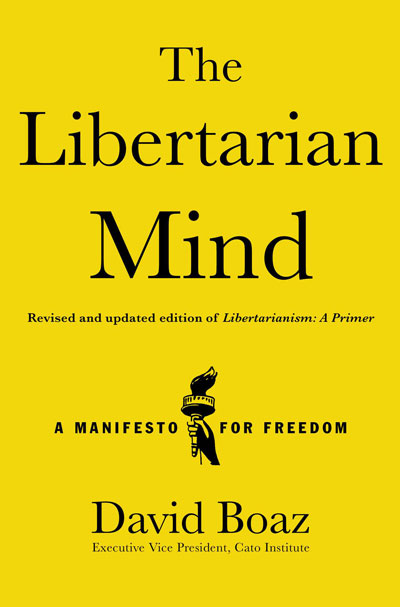
He is the author of Libertarianism: A Primer, described by the Los Angeles Times as “a well-researched manifesto of libertarian ideas”, the editor of The Libertarian Reader, and coeditor of the Cato Handbook on Policy. His latest book is The Politics of Freedom: Taking on the Left, the Right, and Threats to Our Liberties.
Boaz is the former editor of New Guard magazine and was executive director of the Council for a Competitive Economy prior to joining Cato in 1981. His articles have been published in the Wall Street Journal, the New York Times, the Washington Post, the Los Angeles Times, National Review, and Slate.
He is a frequent guest on national television and radio shows, and has appeared on ABC’s Politically Incorrect with Bill Maher, CNN’s Crossfire, NPR’s Talk of the Nation and All Things Considered, John McLaughlin’s One on One, Fox News Channel, BBC, Voice of America, Radio Free Europe, and other media.
Posted on May 22, 2008 Posted to Global,guardian.co.uk,Profiles,Resources,The Guardian
Full profile
David Boaz is the executive vice-president of the libertarian Cato Institute, a non-profit-making public policy research foundation headquartered in Washington DC. He is a leading authority on US domestic issues such as education choice, drug legalisation, the growth of government, and the rise of libertarianism
Posted on May 22, 2008 Posted to The Guardian



 RSS
RSS